
Two in the morning. The puppy is whining.
You lie in bed trying to remember every piece of advice you read before bringing the dog home. “Don’t open it while he’s barking.” “Ignore it.” “If you go to him, he’ll learn that barking works.”
A few minutes later the whining grows louder. Then the barking starts.
At this point the philosophy of learning theory becomes a good deal less interesting, because everyone in the house simply wants to sleep.
And that is why the crate question so quickly turns into one simple one: do you open it or not?
The first question should be a different one
We think the first question should be a different one: what is happening with the puppy right now?
Because the same sound can mean very different things.
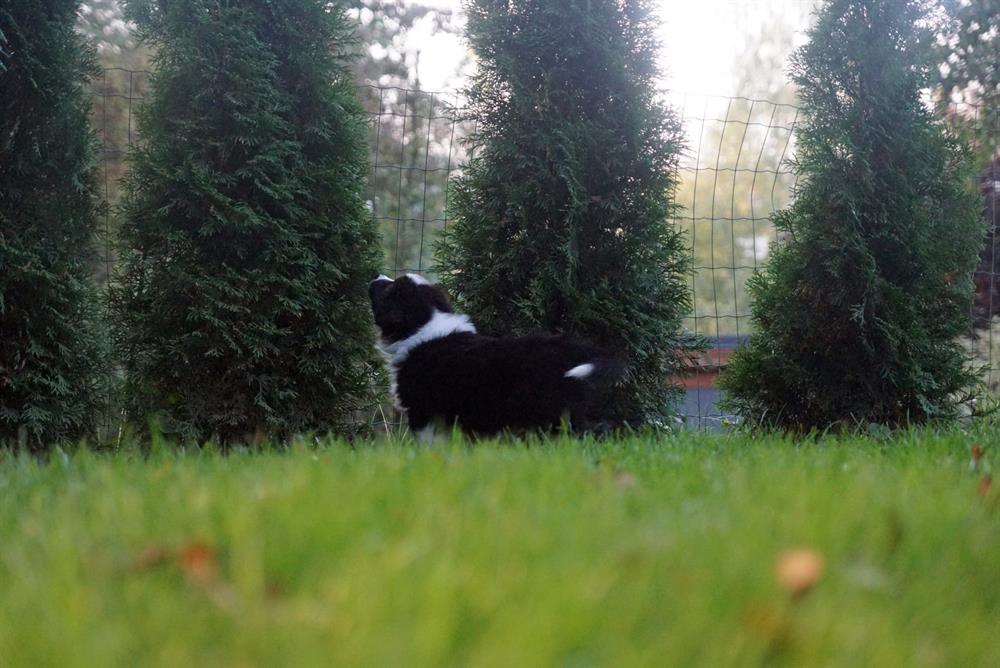
He may be protesting briefly because the fun has ended. He may need the toilet. He may be overtired and completely unable to settle himself. He may be frightened by the new place. He may be too far from the person he is only just learning to attach to. And in some cases we may be seeing more serious separation distress or another problem that needs individual help.
So barking is not a diagnosis. It is only information that something is hard for the dog right now.
A crate or a pen can be a very useful thing. It helps manage the environment safely when we cannot watch the puppy, gives a predictable place to rest, makes travel easier, and comes in handy if a dog ever has to restrict his movement for health reasons.
But all of this benefit rests on one condition: that place must become safe for the dog, not somewhere he is left to “cry it out”.
We do not want a dog who simply learns to be quiet. We want one who learns to rest there.
From the outside these two outcomes sometimes look identical. The dog is quiet.
But a quiet dog is not necessarily a calm dog.
Watch the body, not the clock
So instead of a stopwatch — “five minutes of barking is definitely just protest” — it is far more useful to look at the whole body and state. Can the puppy take food? Are there pauses between the sounds? Is he able to lie down? Are his breathing and movements gradually slowing? Or the opposite — is the intensity rising, the body tightening, the dog trying desperately to escape?

Brief frustration and growing panic are not the same thing.
That is why we dislike the universal rule “never open the door while the dog is barking”. If the puppy needs the toilet, is in pain, or his state is only getting worse, sticking to a rule purely so as not to “reward the barking” is a fine example of a method mattering more than the animal.
On the other hand, not every squeak means you must instantly open the door and organise a night-time festival. Context is what matters here.
In the first nights it helps a great deal to remember what the puppy has just been through.
In a single day he lost practically his entire familiar world: his mother, his brothers and sisters, the smells, the routine and the place. You may be wonderful people to him, but so far you are wonderful people he has known for a very short time.
So expecting a small animal to shut himself in another room on the first night and meditate on his independence for eight hours is fairly ambitious.
The night often begins during the day
Independence is built gradually.

The crate can start being associated with food, chews, short calm rest periods and sleep while you are nearby at first. We increase the time shut in not because the calendar says “day three”, but because we can see that the puppy is already handling the current stage well.
Very often the night’s problem begins during the day. A puppy who has had visitors, games, new places and “socialisation” all afternoon can be so overtired by evening that he physically cannot switch off. From the outside it looks like extra energy, when in fact he needs sleep.
So it is worth looking at the whole day. How much did the puppy sleep? When did he eat? Did he go out before bed? Was the last hour calm, or did it look like a children’s party?
And there are situations where we stop experimenting on our own.
If, when shut in or separated, a dog repeatedly experiences severe and growing distress, tries desperately to break out, drools heavily, risks injuring himself, or if his behaviour has changed sharply, it is worth consulting a vet and a qualified behaviourist. In such situations “let’s wait until he gets used to it” can only deepen the problem.
The point of a crate is not to win a silence contest.
The goal is to raise a dog who can separate safely, rest, and knows that his basic needs will be noticed.
Once that feeling appears, the quiet usually comes by itself.
Invitation: Our families are not left alone with the questions of those first nights. We will help you understand what your particular puppy is showing and when it is worth involving the right specialist.
Source: AVSAB Puppy Socialization Position Statement - crates and pens should be associated with safe rest and with play.